A Tourist In Your Own Home
A Virtual Exhibition: Curated by Shasha Dothan
“A Tourist In Your Own Home” is an online exhibition, curated by artist, Shasha Dothan.
Along with five artists Dothan invited, who are also immigrants to the United States,
they created video works about their 2020 experience. This exhibition looks at each
immigrant’s struggle and the notion of home. Is the new country you live in your home?
Is the country you were born in your home? Being confined at home for the last year
due to Covid 19, immigrant artists may struggle even more with the questions of displacement.
Many questions about home and feeling like you don’t belong become more difficult.
In this online video exhibition, the selected artists will represent different facets
of immigrating to the US. Each artist comes from a different country and culture.
Each has their own story. What they all have in common is living in the US in 2020,
trying to build a future for themselves. The show will ask, will you become a tourist
in the land you were born? And also, are you at home in the land you now live in?
Finally, is the realm of art an alternative home for immigrants?
The artists Jisoo Chung, Marton Robinson, Shirin Bolourchi and Ali Azhari, Tania Zaidi
and Shasha Dothan choose to look at this time in a different way, with a different
perspective and in a different language. All these stories are connected to an individual
experience but share a universal feeling of being lost in translation.
Jisoo Chung
Shasha Dothan
Marton Robinson
Shirin Bolourchi and Ali Azhari
Tania Zaidi
JISOO CHUNG
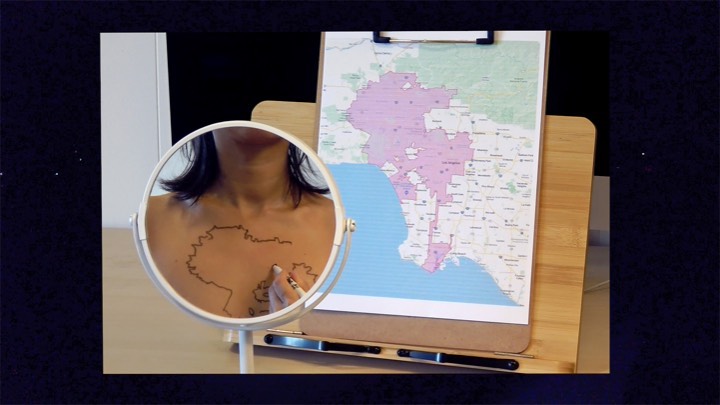
“Deliberate marking, oblivious to itself, but to sing, to sing, very softly” 2020
Artist Bio: Jisoo Chung is an LA-Seoul based multimedia artist working primarily through video and installation. Her work navigates the relationship between individual and systems reflected on technology while considering body, space, and language. Born in Seoul, South Korea, Chung received her MFA from UCLA in the area of New Genres and her BFA from Seoul National University, in Paintings. Chung’s works have been shown in LA and Seoul including Monte Vista Project, LA.; Tiger Strikes Asteroid LA, LA.; Durden and Ray, LA.; 1748 adams, LA; Seoul National University Museum of Art, Seoul; CICA Museum, Seoul; Dongduk Women's University, Seoul; and Dong-shi-sangyoung Screening Project, Seoul. She is a nominee of the ArtSlant Prize showcase winner in the New-media category, a recipient of Human Resources LA Time/Space/Money residency fellowship. Her works will be presented at Korean Culture Center Los Angeles art gallery in April 2021.
Video Description: Deliberate marking, oblivious to itself, but to sing, to sing, very softly> (2020) is about the feelings I had throughout this year - I am living in a moment where my perceptions are limited to minute slices and pieces of time and space, although impacted by the mass factors like global pandemic, political chaos, climate change and an uncertainty of the immigration process. The micro-perceptions and sensations simultaneously create an abstraction and distance. Something too close, but enormously far. Going further, but keep on falling back to the current moments. Touching, but not being able to see. Displacement comes from this place. Uncontrollable, unpredictable, loss of ground, but to sing for the moments. The poem in the video is my response to the book “Dictee(1982)” by Theresa Hak Kyung Cha. The title of the video, and some phrases of the poem are referred from the book.
Marton Robinson
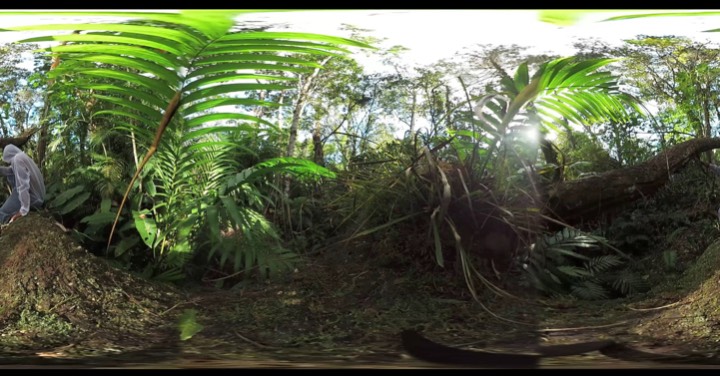
Does Marton have a Title?, 2020
Artist Bio: Robinson’s art, which is informed mainly by African- American traditions, challenges the conventional representations of black identities in art history, mainstream culture, and the official national narratives, especially those of Costa Rica. With an often ironic and rhetorical take on the constructs of racism, this practice endeavors to confront the hierarchies and conceptions inherited from colonialism in order to subvert the mindsets and prejudices ingrained in our social experience.
Robinson has participated in exhibitions in spaces such as as: The Getty Center, Los Angeles, California; Museo de Arte y Diseño Contemporáneo, Costa Rica; Vincent Price Art Museum, California; Fundación Ars TEOR/éTica, Costa Rica; Museo de Arte Costarricense, Costa Rica; University of California, Los Angeles New Wight Gallery,California; Eastside International, California; X Bienal Centroamericana, Costa Rica; Pacific Standard Time LA/LA, CA; Aidekman Arts Center,Boston; Le Palais de Tokyo, France; Bergen Kjøtt, Bergen, Norway; Centro de la Imagen, México; ARTBO, Bogotá, Colombia; Mandeville Gallery, New York; Gallery GVCC, Casablanca, Morocco; Museo Amparo, México; 21st Biennial Contemporary Art Sesc Videobrasil, Brazil; Trienal Internacional de Performance Deformes, Santiago de Chile.
Video Description: The contraposition of two views; an external gaze (tourist, emigrant, artist), and the other look belonging to the landscape as an entity (nation/government). Both gazes are followed when they wander a territory that endures from speculation and preoccupations of the environment.
The videos discuss a relationship that moves in both directions and can refer to migratory dynamics and extraction policies. Both the geography and the inhabitants of a place and its tourists (Immigrants) are participants. The geopolitical displacement of human bodies—both current and historical—where the newcomer is confronted with an ideological normalization by his new host that regards ‘the other’ as alien/stranger. I am concerned with observation processes in which the social and psychological aspects of the interaction between art and the artist, the public, and the environment play an essential role.
The relationship between the politicized black body and the Caribbean landscape is
essential in this context, as thinking about art and how it operates has a central
place in the critical role that cultural signifiers can play in forming a national
identity, specifically, historically displaced Afro-Latinos' self-identity.
For the video production, the images and audios are intentionally factually exaggerated and inconsistently staged by recording in a digital format with a 360 camera, which allows the spectator to interact with the video. Approaching the viewer in the game of gazing, controlling the gaze, and/or observing the tourist (emigrant). The camera captures footage that mimics the Caribbean rainforest and the security cameras used for border surveillance and policing bodies combined with still images of Costa Rica Caribbean Coast; around the area where they recently discovered remains of a sunk shipped that transported black enslaved bodies. It also demands a temporality and attention that goes against the immediacy with which moving image recordings are produced and consumed today.
1 Moskito is a play on the term ‘Miskito’ a reference to an ethnic group in Honduras
and Nicaragua, also Mosquito Coast, a territory that it is believed extended during
Spanish Colonial period from Honduras to Panama. 2 Gloria, Anzaldúa. “Now let us shift
the path of conocimiento inner work, public acts.” In This bridge we call home: Radical
visions for transformation, edited by G. Anzaldúa & A.Keating (pp. 540–578). New York,
NY: Routledge, 2002.
SHASHA DOTHAN
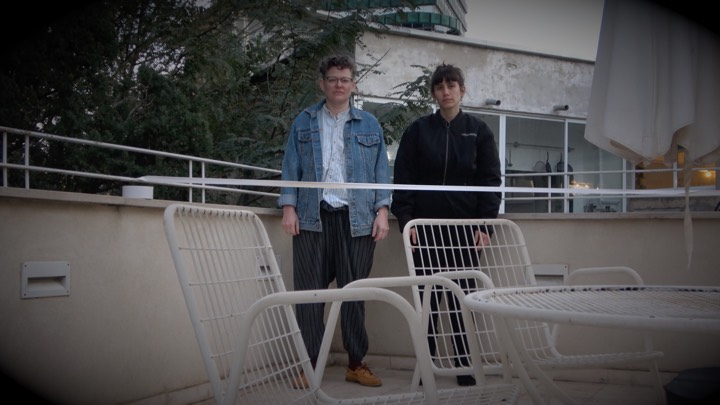
“14 Days”, 2020
Artist Bio: Shasha Dothan (b. 1987 Tel-Aviv) is a Brooklyn-based artist working with video, installation, poetry and sound. She creates immersive experiences that connect fragments of her personal history. Exhibitions include the Ramat Gan Museum of Israeli Art, Ramat Gan; Petach Tikva Museum of Art, Petah Tikva; Blum & Poe, Los Angeles; Human Resources, Los Angeles; Erica Broussard Gallery, Santa Ana; American Jewish University, Los Angeles; Jerusalem Cultural Season, Jerusalem; University at Buffalo Art Galleries, Buffalo: Ashdod museum of Art, Ashdod and MCLA Gallery 51,MA . Dothan received an MFA from University of California Los Angeles (2018), and a BFA from Shenkar College (2013). Awards and scholarships include the John Baldessari Family Foundation Scholarship (2017-18); Young Artist Award from the Israeli Ministry of culture (2018); Word prize from AJU; Asylum Arts Grant; Philip & Muriel Berman Foundation Grant (2019) Adams Family Foundation, Young Artist Award (2020) and the Artis residency grant for Vermont Studio center and NARS Foundation . She was an artist in residence at NARS Foundation, Mass Moca, Byrdcliffe and Vermont Studio center. She is a founding member of the art collective Anti Mehikon.
Video Description: In the beginning of March 2020 my partner and I came to visit my parents for the first time since we were together. A few days after we arrived we were asked by the Israeli government to go into home quarantine.
Text, paintings and music are integrated into the video's narrative, sharing a love
story between two women, one Israeli and the other American in the time of Covid.
The drawings are a marker of the journey that began a year and a half before, spanning
between Israel and New York. Set within the earliest days of the Coronavirus that
influenced and changed our lives, the video “14 days” begins in the first moments
of quarantine as the drawings take a look back at the journey we went through together.
What does it mean to come out of the closet at the age of 30 and what feelings acompany
accepting myself as queer. Questions surface around notions of home, sexual identity
and starting a family according to accepted norms verses according to the life I desire.
Home is a theme that has accompanied me in my work for years and the desire to find
a safe place where I feel I belong.
"14 days'' we are quarantined in my parents’ apartment, the place that always symbolized
home for me, but the room is no longer mine and the home is no longer mine. As isolation
ends and the Coronavirus wanes how will this new world unfold and what will home be
next.
Shirin bolourchi
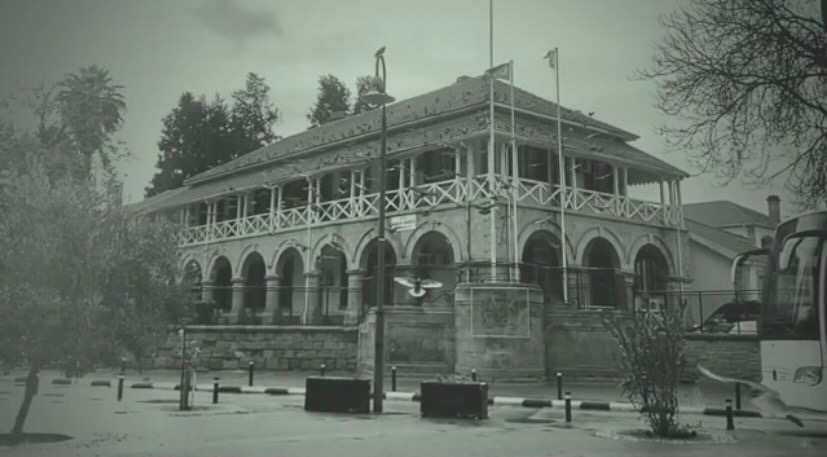
Shirin Bolourchi and Ali Azhari - “Synesthesia Immune” 2020
Artist Bio: Shirin Bolourchi was born on icy December in Tehran-Iran. She is an American-Iranian Fine Artist, Independent Curator, Writer, Poet and Blogger. In 2000, Shirin applied to Tehran Sooreh Art University and was admitted to The School of Dramatic Arts. She was graduated in 2004 with her BFA Degree in Puppet Theater Directing. Following her education, she immigrated to Canada and later to United States Of America to continue her Post-Graduate in Fine Arts. She received her MFA (Master in Fine Arts) from Otis College of Art and Design in Los Angeles.
Meshki Collective, founded by Shirin Bolourchi since 2015. Through research, video,
sculpture, photography, wall painting, and various objects she is curating environments
that submerge viewers in a flood of experiences, which addresses critical thinking.
Her works talk through the paradoxes of migration, identity, philosophy and politics.
Ali Azhari is an Iranian filmmaker and cinematographer holding an M.F.A in screenwriting/cinematography
and has been professionally working in Iranian Cinema as a director of photography.
Currently he is a faculty at ARUCAD University in Cyprus.
Video Description: Myself is all I want to be. Vanta pink is the color of my spirit and Pneuma is my darkest sense. I believe that my last edit was seconds ago. I always revere green when she lives in tribes and forests. I revere green when she stands alone by herself. Knock, and see I'll open the door. Vanish, and see that I 'll make you shine like the sun. Fall, and realize I'll raise you to the heavens. become nothing, and I'll turn you into everything. I am making my own Bible where finding myself is what I am seeking and it is seeking myself, I have an urge to be me, nothing more, nothing less, and that is enough. Where do you live my beloved master? Probably I act like I don’t care, it's not an act.
As many nights endure without a moon or star so we will endure when one is gone and
far.
It’s December in Los Angeles or full bloom in Nicosia. I can hear the smoke loud and
clear. Is that the world's excuse to be ugly? Am I still all in mask? Neither of
us has to explain anything to each other and neither of us makes negative comments,
right?
Sometimes I feel like I want to live far from the metropolis and just walk through
that door. Silence is the language of love, all else is poor translation.
Distance gives us a reason to love harder and love will travel as far as we let it.
What else is there my beloved master? Tell me all about the sun becoming! Do you also have nightmares and sudden explosions? I got that feeling, that you don't know. We hear light and see joy. Our nature is still and silent. From this stillness comes our love.
“In your light I learn how to love. In your beauty, how to make poems. You dance inside
my chest where no-one sees you, but sometimes I do, and that sight becomes this art.”
― Rumi
Tania zaidi

“Glass Tower” 2020
Artist Bio:
Tania Zaidi received her Bachelors in Fine Art from University of California Los Angeles in 2018 and then took a year off after graduation to work in Pakistan and Dubai. Zaidi organized a Mural project named “The Future is Present”, involving a hundred university art students. She is currently a second-year graduate student in the Design and Technology MFA program at Parsons School of Design in New York City. Outside of her degree she is also pursuing teaching at The New School.
Although her focus has been painting for many years, the artist is working on recent
projects concerning new media, coding, video and photography. Through these mediums
she will further investigate post anthropocentrism, her third culture identity and
the relationships between human, animal, plant, rock and technology, using storytelling
and personal anecdotes to guide the narratives.
Video Description:
I was born in Pakistan and have lived between Dubai, Egypt, Los Angeles and am currently in New York. In my works, there is often a journey or decision to be made; either against or in alignment with the pre-existing social order. One can be boxed in and precarious their whole lives or find a way to stability and freedom. Every species has its own method of survival.
For the longest time, I blatantly disregarded parts of my identity based on who I was talking to when asked ‘where are you from?’. This was often to avoid prejudice comments and assumptions about my upbringing, usually because countries like Pakistan are associated with crime or terrorism, and cities like Dubai hold associations of opulence and wealth.
As an immigrant artist, where is home? Is it the land of origin or the land of adoption, or like the nomad; a constantly redefined space. Continuously I move between home and elsewhere, from the familiar to the foreign. As is the process of navigating through life as an artist, there is a deep desire at times for stability, familiarity and a sense of belonging. With the uncomfortable moments however come feelings of gratitude towards the fact that as an immigrant I have more stories to tell and faces to meet than I ever could imagine if I had never stepped outside of my native land.
In this video, I will be exploring the push and pull and the highs and lows of being an immigrant in the USA especially during quarantine; the nostalgia of the desert, experiencing unconditional love and the taste of warm lentils and bread in the evening. I craved for these moments being in lockdown in a glass
tower in Florida during hurricane season. Why did I continue to stay in a land where I will always be an alien, even during a global pandemic?