
MCLA's JED Journey
77% of students agree mental & emotional well-being is a priority at MCLA
MCLA joined the JED Campus program in 2022 with the goal of not only strengthening
its approach to student mental health, but positioning the College as a leader in
comprehensive, evidence-informed campus mental health and suicide prevention. MCLA
sought to benchmark its practices against national best practices, identify gaps,
and build a coordinated institutional approach grounded in evidence rather than relying
on individual programs or services. While students demonstrated strong help-seeking
behaviors and MCLA had committed faculty, staff, and services, significant needs remained
related to mental health, suicide risk, substance use, crisis response, and the coordination
of prevention efforts across the institution. Baseline data reinforced the urgency,
including high levels of anxiety and depression, academic disruption related to mental
health, and concerning rates of suicidal ideation and self-harm.
Over four years, JED helped MCLA move from individual programs and services toward
a more comprehensive, institution-wide approach to student mental health. The College
strengthened screening and early identification, CARE and crisis-response infrastructure,
help-seeking and peer initiatives, clinical and substance-use services, medical leave
and return protocols, postvention practices, and lethal-means safety, while more intentionally
embedding wellness into academic programming, strategic planning, and the broader
student experience.  Although MCLA’s formal JED Campus program concludes in 2026, the work does not. Becoming
a JED Campus Alumni represents a transition rather than an endpoint. MCLA’s enduring
commitment is to continue building a campus where mental health and substance-use
support, suicide prevention, belonging, early intervention, and help-seeking are embedded
in how we support student success - not treated as the responsibility of any single
office or four-year initiative.
“JED gave us an opportunity to look at student well-being through a wider lens - to move beyond individual programs and services and think about the systems, relationships, and environments that shape health. That work aligns deeply with what we believe at MCLA: to do well, you must be well, and creating the conditions for students to thrive is a responsibility we all share.”
JED’s Comprehensive Approach to Mental Health Promotion and Suicide Prevention
JED’s Comprehensive Approach to Mental Health Promotion and Suicide Prevention, a campus-wide framework organized around seven interconnected domains:
- Develop life skills
- Promote social connectedness
- Identify students at risk
- Increase help-seeking behavior
- Provide mental health and substance misuse services
- Follow crisis management procedures
- Restrict access to potentially lethal means
The seven areas are presented as parts of a single circular system, emphasizing that campus mental health and suicide prevention require a comprehensive approach rather than relying solely on counseling or clinical services. The framework is surrounded by strategic planning and equitable implementation, indicating that these strategies should be intentionally coordinated, institutionally supported, and implemented with attention to equity across the campus community.
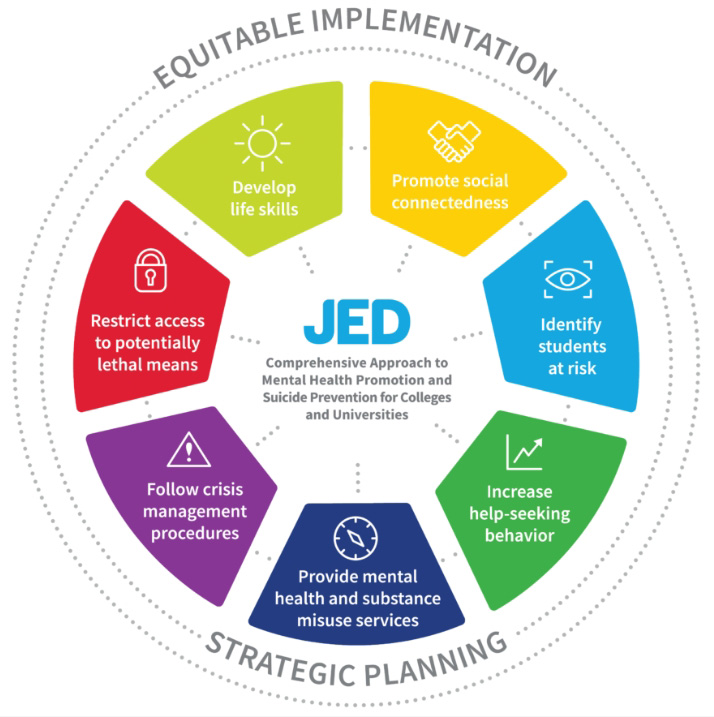
Image source: The Jed Foundation. (2021). JED’s comprehensive approach to mental health promotion and suicide prevention. The Jed Foundation report
MCLA Strengths & Progress
Within the JED framework:
Develop Life Skills
Life Skills & Academic Programming: Robust programming across Health Promotion to Athletics now embedded in the First-Year Seminar and Core Curriculum.
Social Connectedness
Gathering Spaces: Dedicated spaces for specific populations; expanded resources for military-connected and commuter students.
Identify Students at Risk
Screening Opportunities: Regular screening at wellness days and every Health Services, Counseling, or athletic training visit.
Increase Help Seeking Behavior
Online Resources: Crisis and suicide prevention resources consistently accessible on Counseling Services website, ensuring support is available outside of business hours.
Provide Mental Health & Substance Use Services
Triage & After Hours: Daily walk-in hours for urgent concerns. Staff on-call coverage added for after-hours contact, supplementing 24/7 community and national resources.
Follow Crisis Management Procedures
Support Teams: CARE meets weekly, BIT convenes monthly. Expanded reporting resources, including CARE Team reporting access and 24/7 help and crisis lines located on MCLA webpages.
Promote Means Safety
Means Safety Restrictions: Restricted access to windows, rooftops, and sharps. Breakaway closet rods being installed in residences. Lab chemical and medical material access monitored. Firearm Policy
Develop Life Skills
Lifestyle & Wellness Connections: New programming on sleep, exercise, nutrition and their links to emotional health and academic success.
Social Connectedness
Peer Health Education: Launched Summer 2024. Seven student wellness ambassadors per year engage through tabling, social media, a monthly newsletter, and educational programs.
Identify Students at Risk
Support in Transition: Added mental health and substance use questions to incoming health history forms. Developed protocol to proactively connect students with support services before they arrive on campus.
Increase Help Seeking Behavior
Campaigns: Awareness campaigns at wellness fairs, campus posters, and the MCLA Wellness social media page. Normalizing and destigmatizing help-seeking.
Provide Mental Health & Substance Use Services
Naloxone Access: Naloxone available to at-risk students, clinicians, counseling staff, and public safety. Indoor and outdoor naloxone boxes accessible to all campus community members.
Follow Crisis Management Procedures
Postvention Protocol: Updated protocol to fully meet HEMHA best practices. Regular tabletop exercises with all response staff ensure coordinated, timely response after a crisis.
Promote Means Safety
Environmental Scan: Completed scan, identified lethal means risks on campus, and developed a mitigation plan. Regular future scans planned to catch new risks early.
Develop Life Skills
7/10 students feel they lead a purposeful and meaningful life
Social Connectedness
74% students feel social relationships are supportive & rewarding
Identify Students at Risk
60% of students have a lifetime diagnosis of anxiety and 54% with depression
Increase Help Seeking Behavior
12-point improvement in students who feel depressed/keep feelings to themselves
Provide Mental Health & Substance Use Services
5 NaloxBoxes installed on campus
Follow Crisis Management Procedures
401 CARE cases processed in AY 25-26
Promote Means Safety
1 in 5 students meet prevalence benefiting from prevention infrastructure
Sources: The Jed Foundation. (2026). Massachusetts College of Liberal Arts: JED Campus final report.; The Healthy Minds Network. (2026). Report of data from the Healthy Minds Study: Massachusetts College of Liberal Arts, winter 2026. University of Michigan.; The Healthy Minds Network. (2023). Report of data from the Healthy Minds Study: Massachusetts College of Liberal Arts, winter 2023. University of Michigan.; Massachusetts College of Liberal Arts CARE Team. (2026). CARE annual report: 2025–2026. Massachusetts College of Liberal Arts.
TimeLine
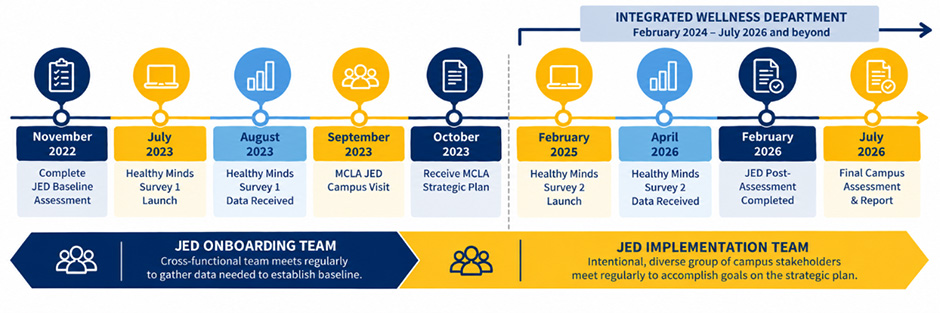
The timeline illustrates MCLA’s four-year progression through the JED Campus program,
moving from baseline assessment and data collection to implementation, evaluation,
and continuous improvement. A cross-functional onboarding team established the foundation
for the work, followed by a diverse implementation team charged with advancing MCLA’s
JED strategic plan through the program’s conclusion in 2026. By the end of the program,
the implementation team advanced each of the over 80 metrics identified in JEDs strategic
plan - all aimed at creating a safer, healthier MCLA.
Running parallel to this work, MCLA established an intentionally designed, integrated
Wellness department in 2024, creating institutional infrastructure for a more coordinated
and comprehensive approach to student well-being. By bringing together Health Services,
Counseling Services, Health Promotion, Peer Health Education, and the CARE Team, Wellness
connects prevention, early intervention, clinical care, and student support within
a shared structure.
In short, JED provided the framework for assessing, guiding, and strengthening MCLA’s
approach; Wellness at MCLA provides the enduring institutional structure to sustain,
integrate, and advance that work.
The Jed Foundation (jedfoundation.org)
The JED Foundation - Instagram
The JED Foundation - LinkedIn
The JED Foundation - X (@jedfoundation)
The JED Foundation - Facebook
The JED Foundation - TikTok
The Jed Foundation - YouTube
Healthy Minds Network (healthymindsnetwork.org)
Healthy Minds Network - Facebook
Healthy Minds Network - X (@healthymindsnet)
Healthy Minds Network - Instagram
Healthy Minds Network - LinkedIn